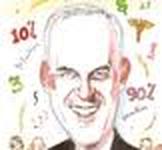

I still see him stepping off the puddled curb in front of my office—tall, neatly pressed suit, worn leather briefcase in one hand, a faint sheen of Pacific Northwest drizzle curling his collar. He was an actuary, and anyone who’s met one knows they spend their early professional years locked away under the harsh glare of desk lamps, pouring over probability tables and unyielding exam syllabi. Actuarial exams aren’t a weekend hobby—they’re a gauntlet of pure mathematics, statistical theory and footnote-driven jargon. You live and breathe them for years because the payoff—sky-high salaries, relatively low burnout—makes the sacrifice of Friday nights at smoky bars or late-summer lake trips seem almost trivial. If you don’t know what an actuary is—if these lines on a page mean nothing to you—then why, pray tell, are you reading this blog/book?
To win the title “actuary” you need razor-sharp intelligence, clockwork discipline and a willingness to let your social life atrophy under the weight of flashcards and sample problems. While classmates danced at keggers, most actuaries were at desks, sipping cheap instant coffee to fuel yet another five-hour marathon on conditional tails and survival curves. As a consequence, their emotional muscles often remain underdeveloped. In corporate hallways they’re jokingly called “accountants with personalities” (or maybe it’s the other way around), and ask them about the murkier realms—psychology, situational leadership, the unpredictable ebb and flow of human behavior—and you might as well be asking them to square the circle.
Back in the mid-eighties, I was running a recently acquired branch out near Seattle. The overhead lights buzzed in the lobby, the walls papered in mission-statement platitudes. He phoned from the Midwest—same stoic Midwestern accent I remembered—and asked if he could fly out for lunch. He’d just signed on to lead a fifty-person operation in Milwaukee and, with that same anxious cadence, said, “Dave, I’ve never managed anyone. Can you tell me what I need to do to be a good manager?” He promised no more than thirty minutes, maybe forty-five, and a couple of sandwiches.
When he arrived, the rain dripping off his polished wingtip shoes, I led him through the glass door and down to a corner table at a seaside café. The smell of fried onions and saltwater blended with the steam rising from our mugs of dark roast. Before our plates arrived he produced a pristine legal pad, its edges crisp, and flipped it open. He leaned in, pen poised like a surgeon’s scalpel.
At first he buttered me up—called me an effective leader, someone who got measurable results. My inner smart-aleck flickered to life. “I thought you’d ask something hard,” I said, sliding my spoon against the bowl’s rim. But when he blasted straight to the point—“What’s the formula, Dave? How do I lead fifty people to success?”—I realized he was serious.
I told him leadership wasn’t a plug-and-play algorithm you could cram onto a three-by-five card. It wasn’t like calculus, where you feed in x and spit out y. It was more akin to asking me in forty-five minutes to turn you into a scratch golfer. Maybe you’d make par once in a blue moon, but your chances were slim if all you’d ever done was study putt-line geometry in textbooks. I sketched out the chaos of leadership: the way personalities varied like shifting currents, the need to read moods that had no neat distribution curves, the way a rigid social style could fracture under the weight of individual quirks. He scribbled furiously, eyes darting between my mouth and the blank margins.
When our burgers arrived, I watched him tear at it like a man starving for direction. But he got up from that table more confused than when he’d sat down.
Over the next months he devoured leadership tomes I recommended—books with titles like Management in Small Doses, Out of the Crisis, and Adaptive Management—but every phone call ended in frustration. I even flew to Milwaukee, walked its fluorescent hallways and smelled the faint aroma of copier toner in his office. Yet in the end he flopped spectacularly as a manager. He did, of course, go on to make a small fortune as the engineer of a brilliant convolution program for setting claim reserves, —his mind still a fortress of raw intellectual firepower—but the social and structural instincts of a leader eluded him.
I tell this story in every leadership seminar I used to run before I retired, watching faces fix on mine as I lean forward and ask, “Do you really want to know?” Because if you’re hunting for a shortcut, a three-step prescription that guarantees you’ll crush it in any endeavor—if you want to purchase a crystal ball or a bullet-proof playbook—you’ll be sorely disappointed. In every field, variation reigns. It’s vast, ever-shifting, a roiling sea of chaos that laughs at your neat formulas and rigid certainties. No one—no matter how brilliant, no matter how many exams they’ve passed—can tame it with a single equation.
 Old Man Pondering
Leave a comment