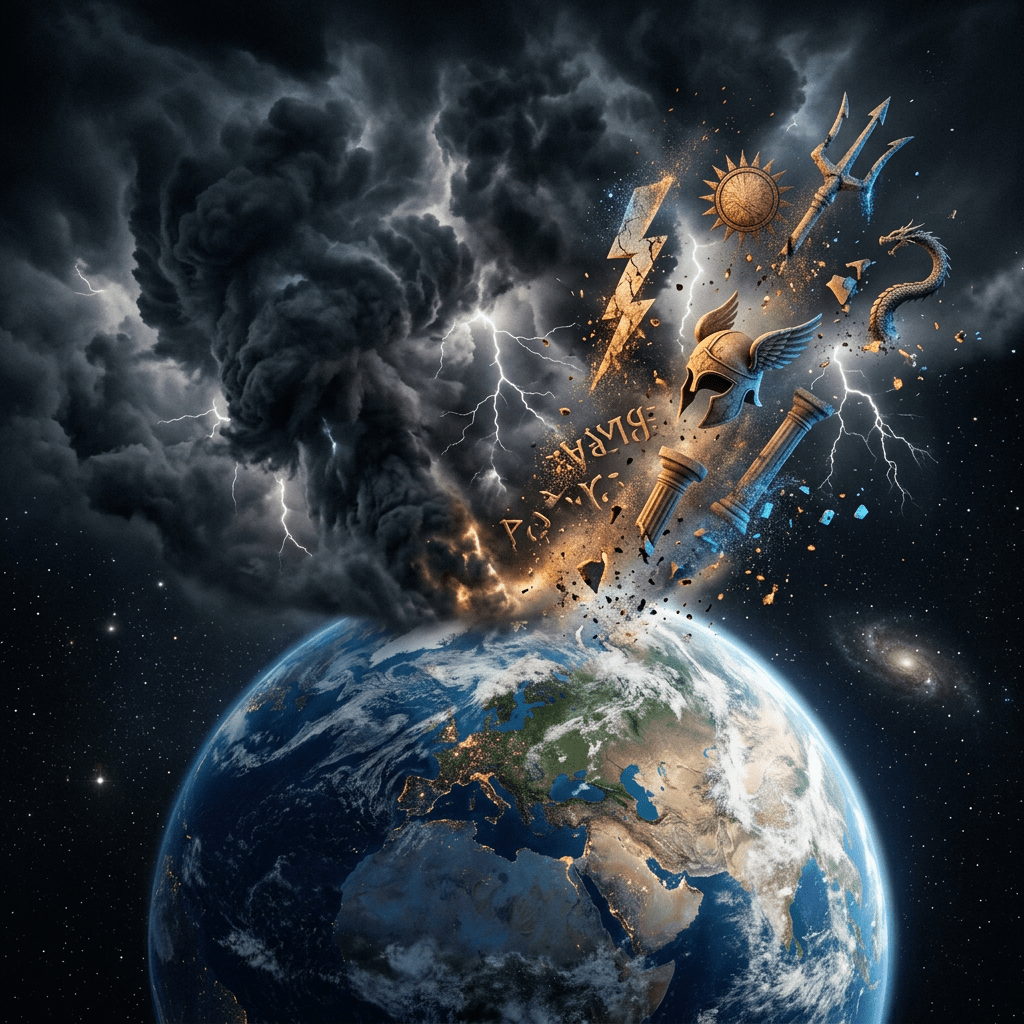
At age 74, I can see the end of the road from here—not as a distant smudge on the horizon anymore, but as a fixed point, close enough to make out its details. Unlike many of my “older” family and friends I have to stay true to myself and the truth. You see, I would love nothing more than to believe in some luminous beyond, an afterlife, some continuation, but I have never been able to make myself believe something simply because it would be a comfort. The truth I know is this: I am part of a species “Homo Sapiens”, which translates to “wise man”. We are the only surviving member of the genus, and we got lucky.
Somewhere along the long chain of mutation, evolution, and adaptation—through the blind groping of single cells toward light, through the slow catastrophe of fins becoming limbs, through a hundred million years of creatures eating and being eaten—we ended up with a brain capable of asking the question, is there something more or something greater? I have never been able to decide whether that is the most remarkable thing about us, or the most tragic.
So, is there something greater? The question has haunted every civilization that ever looked up at the night sky and felt small. Forty-five hundred years ago, the Egyptians built a god for every force they could not explain and stacked stones the size of houses to honor them. The Greeks gave their gods jealousy and lust and petty grudges, because what is more frightening than a universe with no one in charge, and what is more comforting than one where even the divine make the same mistakes you do. Today, somewhere between 4,000 and 10,000 religions, and an innumerable number of cults, worldwide are still working on the answer.
So, here’s the truth, and many of you will absolutely hate me for saying this. Cults and religions are simply a bunch of bull. Nature Boy, the self-proclaimed messiah who wandered the California hills in a loincloth preaching raw vegetables as the path to God. Charles Manson, who rewired the Book of Revelation through Beatles lyrics until his followers were ready to kill for him. Jim Jones, who marched nine hundred people into a Guyanese jungle and handed them paper cups of cyanide-laced Flavor Aid in the name of apostolic socialism. The Branch Davidians, who burned alive in Waco while David Koresh played electric guitar and waited for the Fifth Seal. Heaven’s Gate, who castrated themselves and packed their bags for a spaceship hiding behind the Hale-Bopp comet. The Movement for the Restoration of God’s Ten Commandments, who locked their congregation inside a church in Uganda and set it on fire. The Boy Scouts and their focus on God, which now face over 82,000 sex abuse claims, which have now been revealed as a pervasively corrupt organization that protected pedophiles.
With these truths in mind, I recently had a discussion with a woman about politics. It devolved into an argument about religious beliefs. She started out reasonable enough—arms crossed, voice measured, citing things she had read or half-remembered hearing. She presented herself as an independent woman reasoning her way toward a conclusion. Then, when her arguement thread ran out, she finally exclaimed that she believed in the Bible, as if that would close the conversation. It didn’t because I immediately said, “Well great, because I believe in the Quran.” Of course I do not, but I wanted her to hear how stupid her Bible comment sounded from the outside—how quickly a conversation about the real world becomes a conversation about which book you were handed as a child.
A few seconds after my comment landed, she turned away from me entirely—physically rotated in her chair—and murmured to a relative sitting beside her, as though I had already left the room, She whispered that none of what we were discussing mattered anyway, because the Bible told her we were living in the End of Times. Her relative nodded slowly, with what I found the hilariously solemn gravity of someone receiving important news.
I have heard variations of this maneuver my entire life: the quiet pivot away from the argument, the shoulders turning, the eyes finding somewhere else to be, the voice dropping to a register meant only for the sympathetic ear beside her. The appeal to an authority so total it renders the conversation itself a triviality—not the argument, but the room, the chairs, the window, the whole stubborn material world—all of it dissolved in a single whispered arrogant sentence which convinces light minded people everything can be safely filed under God’s plan and forgotten. How very stupid!
Long ago I learned that humans turn to religion for the same reasons they want to believe in anything that makes the dark feel smaller and the poor feel as relevant as Elon Musk: it answers the questions that would otherwise howl unanswered in the small hours of the night—where did we come from, what happens when we die, why did my child and not yours leave us—and it binds strangers into communities with a shared purpose.
Religion also simplifies parenting for the adults who would rather hand a child a finished answer than sit with them in the mess of an unfinished one—who find it easier to say because God says so than to reason a thing through out loud, in plain words, in front of someone small enough to notice when the reasoning falls apart. It’s so easy to have religion hand down a ready-made map of right and wrong before a child is old enough to draw one for themselves, before they have even learned to be lost. The brain that conjures God is the same brain that evolved to find patterns in rustling grass, to see the tiger before the tiger sees you. It was never built for comfortable uncertainty. It was built for survival, and survival has always preferred a clean answer to an honest one.
So, without religion, where did we actually come from? Of course, I learned that life on Earth began through abiogenesis—simple organic compounds transitioning into living cells somewhere between 3.8 and 4 billion years ago. Amino acids formed in the ocean, arrived on meteorites, or were shocked into existence by lightning. RNA likely came before DNA, acting as both genetic code and catalyst, eventually learning to copy itself.
We all know (and I am being terribly facetious here of course for the religious zealots who refuse to try to learn anything because it might make them question their fictional religious beliefs) that 74 years ago in 1952, scientists Stanley Miller and Harold Urey built a sealed glass apparatus and filled it with what they believed early Earth’s atmosphere to have been: water vapor, methane, ammonia, and hydrogen—a warm, lightless, lifeless soup. Then they ran electrical sparks through it to simulate lightning. Within a week, the inside of the glass had turned a deep reddish-brown. When they analyzed what had formed, they found amino acids—the molecular chains that proteins are made of, and that all known life is made of. (Yep, this knowledge is almost a century old already!)
Today, even though science, data and truth can easily be found, there are those estimated 4,000 to 10,000 distinct religions worldwide—cargo cults in Melanesia that worship the ghost of a World War II supply plane, snake-handling congregations tucked into the Appalachian hills, ancient animist traditions that see a god in every river and stone. And yet, for all that variety, over 77% of the global population follows one of just four major traditions: Christianity, Islam, Hinduism, and Buddhism. The rest is a long tail of belief stretching off into the dark, too alive and too strange to count.
Everyone of course thinks their chosen religion is the correct one—the single clear signal in all that noise—and yet Christianity alone, that one branch of that one tradition, has fractured itself into over 45,000 distinct recognized denominations worldwide, each one presumably the right answer, each one presumably what God had in mind all along. (Pew Research Center Religious Global Landscape)
You see religion and mythology are deeply intertwined—two roots of the same tree, so tangled at the base that separating them is more surgery than scholarship. Mythology is the collection of sacred stories a culture tells itself: the flood that swallowed the world, the god who stole fire, the hero who descended into the underworld and came back changed. Religion is what gets built on top of those stories—the pews and the incense and the collection plate, the dietary laws and the burial rites, the prayers repeated so many times they lose their words and become pure rhythm.
Now let’s get back to the “End of Times” foolishness, which is almost as preposterous as the classic religious comment “Everything Happens for a Reason”. These mythical sayings sit atop humanity’s towering pyramid of comforting delusions—phrases whispered in hospital waiting rooms, muttered at rain-soaked funerals, and embroidered onto decorative pillows in suburban living rooms across America. These platitudes, which have been repeated throughout human history, form the cornerstone of elaborate theological architectures where a celestial supreme being maintains spreadsheets of human behavior.
According to these incredibly unscientific opinion-based fictions, a divine bookkeeper presides over a bubbling brimstone and flesh-melting flames, where the screams of the damned provide background music for those who colored outside his moral lines. Yet the bookkeeper loves you, and this same all-powerful, all-knowing entity amazingly requires your constant financial contributions, preferably at least 10% of your income called a tithe. Gee, I wonder why such an amazing and all-powerful bookkeeper needs so much of your money?
I’m sorry and I apologize to all the folks that have to believe in foolishness to achieve comfort, but please forget the bullshit and ignore the often-miserable people who believe in their selected religious crap as they wait for the end of times. Instead, live the life you have while you have it. Spend your money and time donating to honest charities that do good for others without creating manipulative fantastical fictions. Enjoy nature, movies, books, hobbies, technology, science, new knowledge, your pets, games, your children, the world and its people. Love your friends and your family while you can and stay positive about what you have and what’s to come, whether you have ten or ten thousand days left on this Earth.
Such should be life.