

I started thinking about creating articles that would cut through the fog of today’s headlines like a lighthouse beam—illuminating the jagged rocks of misinformation that shipwreck public discourse. As my fingers hovered over the keyboard, poised to unleash a torrent of personal grievances, I caught myself violating my cardinal rule: facts and data over opinions and diatribes.
That’s when it struck me—I should dissect these inflammatory topics with precision, extracting the TRUTH from beneath layers of media sensationalism, where cherry-picked statistics and manufactured outrage have replaced substantive analysis, leaving viewers intoxicated on emotional spectacle rather than soberly informed. The mind-numbing foolishness of digital echo chambers—where cherry-picked statistics and context-stripped video clips circulate like communion wafers—and the Grand Canyon-sized gulf between worldviews—parallel realities—is what I’m examining today.
In my last post, I explored the delicate balance between understanding human variation and the searing pain that comes from ignoring it. You see people today feast on drama or sensory carnage—a sobbing mother clutching deportation papers on evening news, mascara-stained tears tracking her cheeks; a teenager’s fractured skull on wet pavement. Our attention gorges on screaming headlines that flash across our screens, pupils widening with each notification. Meanwhile, substantive truth—methodical data in government reports and peer-reviewed research that might actually illuminate our path—remains neglected like vegetables abandoned on a child’s plate.
We consume spine-tingling anecdotes while rejecting statistical analysis that demands cognitive effort. Why? Because these visceral narratives confirm our existing beliefs with sniper-like accuracy, delivering selectively curated evidence that reinforces our mental frameworks. We mistake the blinding flash of isolated incidents for the steady illumination of reality. Like disoriented moths, we crash repeatedly against the nearest bright distraction while the vast constellation of interconnected truths extends ignored above us.
So you want the truth based upon data, analysis and research? The kind that emerges from credible spreadsheets, graphs and surveys? Trust me, some of these truths will slide into your belief systems like a key into its lock, but many will stick in your throat like fish bones. The systemic data—those cold, unyielding numbers glowing on my monitor at 3 AM—defines a truth that stands immovable as granite. Why the truth is what it is, is another subject as people elect to blame others if it’s bad and claim credit if it’s good. I have spent decades watching both sides cherry-pick convenient statistics, as they define cause versus effect. I will tell you what is, not why it is. In other words, the truth dictated by the data remains etched in silicon whether it makes you nod in righteous satisfaction or sends you storming away from your screen.
I will dissect one pressing issue each week with surgical precision, using data to strip away the emotional hyperbole that clouds our judgment. My scalpel will cut through everything from the invisible tax of inflation that affects your wallet, to the crime statistics manipulated by both parties, to the silent epidemic of fentanyl deaths ravaging small towns, to the eroding trust in institutions once considered sacrosanct, to the casino-like volatility of Wall Street, to the human drama associated with immigration enforcement. Consider this your weekly inoculation against the contagion of misinformation. Now, let’s begin this week’s autopsy.
What’s the truth about Inflation?
As of January 2026, the naked truth about inflation is that the breakneck pace has slowed. The annual inflation rate stands at 2.7% for the 12 months ending December 2025. That’s down slightly from the prior year, and down considerably from the recent over 8.0% peaks in 2022.
Here’s the inflation breakdown for November 2025 — in one chart
With all this said, if you think a 2.7% annual inflation rate is high and things are awful, you’ve never witnessed the economic maelstrom that engulfed America in the late 1970s. Those of us who began our earning careers as young parents back then remember mortgage rates that soared past 18%, gas lines that snaked for blocks as prices tripled overnight, and grocery bills that seemed to inflate between the checkout line and the parking lot. We recall the sickening lurch in our stomachs when opening utility bills that had doubled in a month, the calculations at kitchen tables about which credit cards had a little more room and which necessities could be postponed another week.
Here is a chart for historical comparison purposes only.
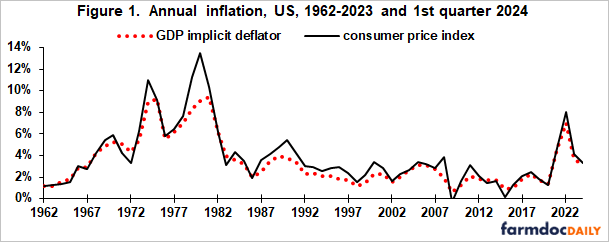
Yes my dears, inflation is as inevitable as gravity—an economic constant that pulls prices ever upward through the atmosphere of commerce, and I hope these lessons of truth improve your perspectives.
The cost of everyday necessities—from the marbled steaks glistening under supermarket lights to the gleaming sedans on dealership lots—always ascends like heat from summer pavement. Your responsibility, if you aspire to better your personal economic position in this relentless fiscal climate, is to ensure your income and earning potential rise like mercury in a thermometer—faster than the surrounding temperature of inflation—not to bitch and moan as prices continue their predictable climb. So “cut the crap” and quit your whining! Today’s modest 2.7% inflation rate barely registers with us silver-haired veterans of the 1970s economic battlefield, for reasons I pray you’ll never comprehend firsthand.
 Old Man Pondering
Leave a comment